


A little history about football matches on Christmas Day...
Without doubt the most famous Christmas Day football match of all time took place in 1914, when one of the deadliest conflicts in human history was paused for a kick-about. The First World War 'Christmas Truce' saw around 100,000 troops along the Western Front exchange gifts, sing carols, and play football. The match has reached mythical status, but letters from soldiers provide evidence that it did take place. A recently uncovered letter written by Staff Sergeant Clement Barker of the 1st Battalion Grenadier Guards explains how the match started.
“A German looked over the trench – no shots,” he wrote. “Our men did the same, and then a few of our men went out and brought the dead in (69) and buried them. The next thing, a football [was] kicked out of our trenches and Germans and English played football.” Sergeant Barker survived the war, but more than 16 million soldiers and civilians were killed.
The suspension of league football and the absence of players during the First World War led to the emergence of several women’s teams, the most popular of which was Dick, Kerr’s Ladies – who played their first match on Christmas Day 1917. Festive celebrations were understandably muted, with friends and loved ones fighting abroad, but it was felt that a Yuletide football match could provide spectators with a much-needed boost and raise money for charity.
The players, led by captain Alice Kell, were wartime munitions girls who worked at a Preston factory owned by Messrs Dick and Kerr. The match was played at Deepdale against Coulthard’s factory, and Dick, Kerr’s won four-nil. Ten thousand fans watched the Christmas spectacle, raising £488 for a local hospital.
Christmas Day football continued during the Second World War and delivered a stockingful of goals. On December 25, 1940, Norwich faced a Brighton & Hove Albion team that arrived with only five players – one senior, three juniors and a loanee – and cobbled together an XI using volunteers from the crowd. Norwich won eighteen-nil, with Fred Chadwick scoring six.
The 40 wartime league matches played on Christmas Day 1940 provided 210 goals. Southend beat Clapton Orient nine-three, Bournemouth beat Bristol City seven-one, Mansfield beat Stoke seven-two and Bury and Halifax drew five-five.
Several teams played two games that day. Leicester lost five-two at Northampton in the morning, then Northampton lost even-two at Leicester in the afternoon. With guest players allowed to turn out for different teams, Tommy Lawton played for Everton against Liverpool in the morning, and for Tranmere against Crewe in the afternoon. And Len Shackleton played for Bradford Park Avenue against Leeds in the morning, then scored for Bradford City against Huddersfield in the afternoon.
The origins of playing football over the festive period revert to the nineteenth century with Christmas Day itself playing a major part, often a double header with Boxing Day when a team might play the same opponent home and away on consecutive days. It was par for the course in those days, and if it were not back-to-back games, it would be Christmas Day and 27 December, time to go back to Christmas past.
In 1888, Everton played two matches on Christmas Day, then another on Boxing Day. All three matches took place at Everton’s pre-Goodison home, Anfield. On Christmas morning they played a Lancashire Cup tie against Blackburn Park Road, coming from behind to win 3-2. Then in the afternoon they played an annual exhibition match against Ulster FC, winning 3-0, with goalkeeper Charles Jolliffe scoring the third goal to the great amusement of the 2,000 spectators. The Boxing Day match against Bootle was less amusing, being played in a shower of hailstones, and ending as a goalless draw.
The first Football League match to be played on Christmas Day was Preston North End versus Aston Villa in 1889. Preston’s 'Preston’s ’Invincible’s' were the reigning league champions, but Villa had won the earlier meeting between England’s top two sides. This was a real Christmas cracker, and 9,000 spectators postponed their turkey dinners to see it, making it one of the highest-attended games the fledgling league had seen. Man of the match was Preston’s Nick Ross, the fearsome defender-turned-forward who terrified opponents by hissing at them through a crooked set of rotten teeth. Ross gave Preston an early lead, but Villa hit back with two goals before half-time. In the second half, Ross hit a long-range equaliser and then claimed his hat-trick with a “lightning shot.” A hard-fought game ended 3-2 to Preston, who went on to win the league for the second season running.
As the Football League expanded, clubs began to travel longer distances for Christmas Day matches. There was no public transport shutdown, so fans and players could take trains and buses for festive away trips. It was customary to play return matches on Christmas Day and Boxing Day against the same opponent, to ensure that paired-up teams had equal distances to travel.
In 1908, the return matches produced a series of mirrored results. For example, Manchester City beat Chelsea two-one on Christmas Day, and Chelsea beat City by the same score on Boxing Day. And Bristol City beat Bradford City one-nil, then Bradford City beat Bristol City one-nil.
In 1909, a Christmas Day match between Partick Thistle and Hibernian ended in tragedy when Hibs and Scotland defender James Main suffered a fatal injury. Partick’s Firhill pitch was covered in ice, and Main told colleagues they were “risking life and limb” by playing on the treacherous surface. Just before half-time, he took part in an accidental slippery clash with Partick’s Frank Branscombe and was carried from the pitch with severe bruising and stud-marks on his stomach. The depleted Hibs eventually lost three-one. Main went home, but was later rushed to hospital, where it was discovered that he had a ruptured bowel. An emergency operation could not save him, and he died on the following day.
Playing football on a religious holiday was a contentious issue at a time when Sunday football was still banned, and some footballers abstained from playing in Christmas Day matches. Participation was voluntary, with FA rules at the time stating that “no club shall be compelled to play any match on Good Friday or Christmas Day.” Star players, like England internationals Arthur Bridgett of Sunderland and Harold Fleming of Swindon, refused to play on religious grounds.
And, up until 1925, the entire Arsenal team were prevented from playing Christmas Day matches on their own religious ground. The land Highbury was built on was owned by St John's College of Divinity, and the terms of Arsenal’s lease prohibited them from playing matches on religious holidays. But Arsenal bought the land in 1925, and at 11.15am that Christmas morning they played their first Christmas Day match, against Notts County, in front of 33,500 fans. Arsenal won three-nil, with Charlie Buchan among the scorers.
The busy festive fixture list proved extremely lucrative for clubs but was not so popular with players. Many were committed drinkers, and unable to resist seasonal excesses. Some clubs even provided their players with alcohol as a Christmas treat. Clapton Orient striker Ted Crawford, later a popular manager and raconteur, recalled his entire team turning up drunk for a Christmas Day match against Bournemouth in 1931 courtesy of a barrel of beer provided by their manager. Crawford was unable to see straight and ended up collapsing on the pitch in a sozzled heap. Clapton (now Leyton) Orient lost 2-1 but sobered up sufficiently to win the Boxing Day return match one-nil.
On Christmas Day 1937, it was fog rather than alcohol that hung over football. Britain was covered in a thick grey blanket, forcing many league games to be postponed or abandoned. The game between Chelsea and Charlton at Stamford Bridge went ahead, and both sides scored a goal, but in the second half the fog thickened, and Charlton keeper Sam Bartram began to lose sight of his team-mates. “We were on top at this time,” he remembered in his autobiography, “and I saw fewer and fewer figures as we attacked steadily.” Bartram paced up and down his goal-line, assuming that his side had the opposition pinned in their own half. After several lonely minutes, a figure appeared from the fog. “What on Earth are you doing here?” enquired a puzzled police officer. “The game was stopped a quarter of an hour ago. The field’s completely empty.” “When I groped my way to the dressing room,” wrote Bartram, “the rest of the Charlton team, already out of the bath and in their civvies, were convulsed with laughter.”
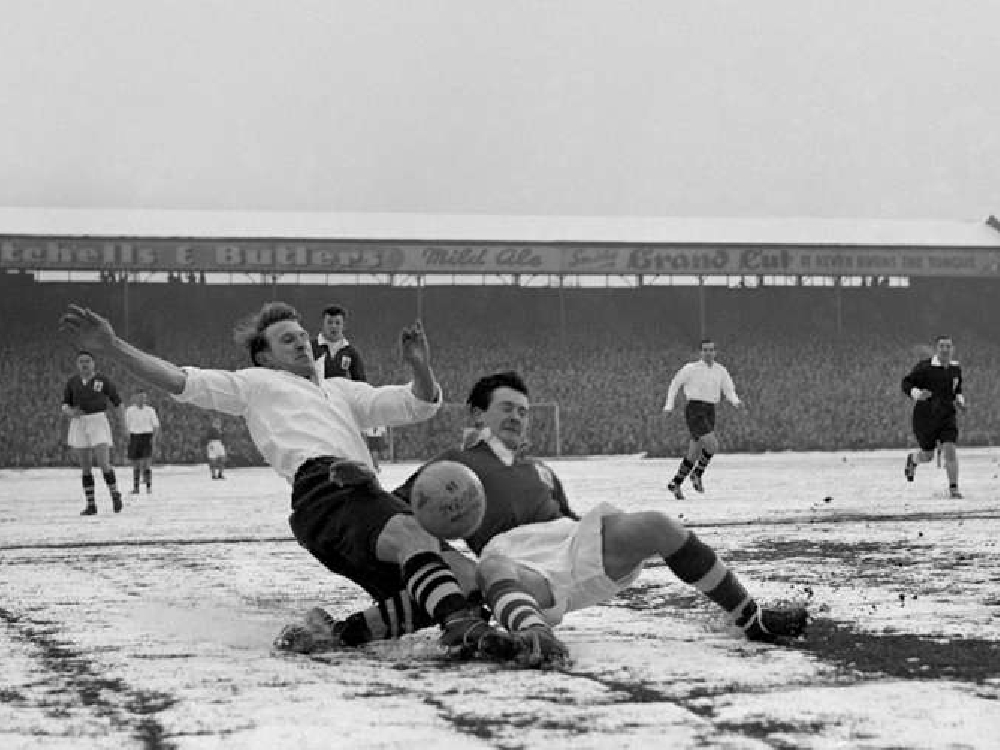
As far as white Christmases go, the Christmas of 1956 was one of the whitest on record. However, although severe weather and a petrol shortage kept many spectators at home, all the Christmas Day fixtures went ahead. 1950s footballers were a hardy breed, and games were played in three inches of snow and driving winds. There was only one submission to the elements – Coventry’s match at Newport was abandoned due to a snowstorm, and the return match on Boxing Day was postponed.
Christmas Day 1957 was the last with a full league programme. The arrival of floodlights and evening games had removed the need for fixtures to be squeezed into public holidays, and many fans were preferring to stay at home with their families on Christmas Day. In the First Division on December 25, 1957, Blackpool beat Leicester 5-1, Manchester United beat Luton 3-0, and Sheffield Wednesday and Preston drew 4-4. Chelsea beat Portsmouth 7-4, with 17-year-old Jimmy Greaves scoring four for the Blues.
In 1958 there were only three First Division matches played on December 25, and in 1959 just one. The last English League match played on Christmas Day was Blackpool versus Blackburn in 1965. A crowd of 21,000 turned up to see Blackpool win 4-2. In Scotland, where Christmas Day football was not as big a tradition as it was in England, football was only played when December 25 happened to be a Saturday. The last matches played were Clydebank versus St Mirren (2-2) and Alloa versus Cowdenbeath (2-1) in 1976.
A planned revival of Christmas Day matches failed in 1983. Third Division Brentford had arranged to play Wimbledon at 11am on Christmas morning. “We hope to revive the old tradition of the husband going to football on Christmas Day while the wives cook the turkey,” said Brentford official Eric White. However, the sexist plan backfired, and protests by both sets of fans saw the match brought forward to Christmas Eve. Wimbledon won 4-3.
 Big win for our rugby players
 Playing or watching

