

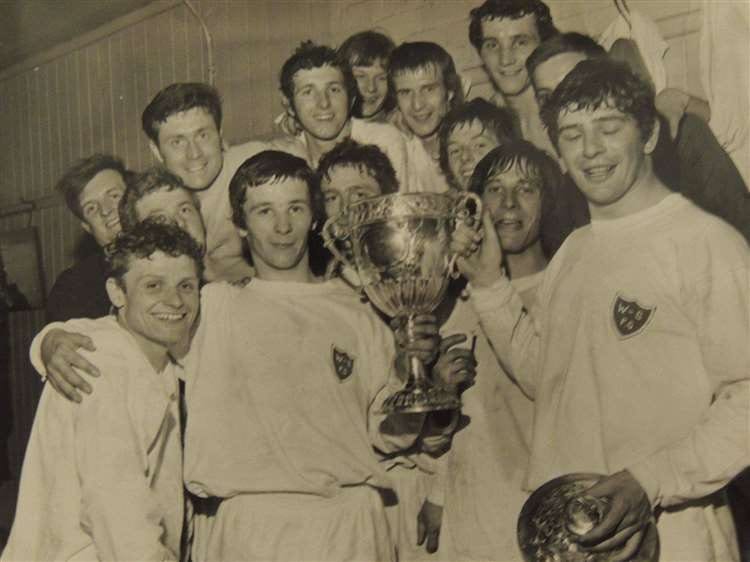
The story behind the changing face of Nottinghamshire football, from thirty leagues to just one in 125 years,
During the first two decades of the twentieth century, around thirty leagues were formed, many named after counties or towns. Some reflected local industries, including the memorably titled Nottingham & Derbyshire London Midland & Scottish Railway League, which lasted just one year, and the Collieries League, which covered both Notts & Derbyshire for six years in the mid-1920s. Others had a social purpose, such as the Sunday School, Church, and Congregational leagues, which aimed to steer men away from drink. Bulwell, Radford, and Hucknall all ran district leagues of their own. Bulwell tried three times between 1894 and 1965 before eventually joining the Notts Combination. The Radford league lasted twenty-three years, ending at the outbreak of the First World War, while Hucknall’s, founded in 1894, continued until 1936. Nottingham briefly had an unemployed league in the mid-1930s, and Raleigh operated an inter-departmental league for its workers in the 1950s.
While many leagues disappeared quickly, others survived for generations. The Notts Alliance lasted 105 years before a damaging split brought it down and led to the formation of the Notts Senior League (now renamed Nottinghamshire Football League). Founded in 1906, the Notts Amateur League served clubs below the standard of the single-division Notts Alliance. It later joined with the Midland Amateur Alliance to form the Notts Amateur Alliance, which folded in 2019 as the Senior League grew. The Nottinghamshire Combination League began in 1896, folded when the Second World War broke out, and was revived in 1950. Mainly drawing clubs from the city area, it once ran three divisions, but by the end had only ten teams left. In the 1970s its standard was strong, with both Ruddington sides, Village and F.C., joined by Cotgrave Colliery, Hazel Grove Celtic, Bestwood Colliery, Kimberley MW, and Bulwell Forest Villa. The Nottingham Spartan League was absorbed into the Midland Amateur Alliance in 1996, its eighty-sixth year. Worthington-Simpson, now Newark & Sherwood United, won back-to-back titles immediately after the Second World War. In 1955–56, Clipstone completed a treble, adding the League Cup and Notts Intermediate Cup to the league title at Baulker Lane.
By the start of the Covid pandemic, those thirty leagues had been reduced to just one. Formed in 1893–94, the Newark & District League provided Saturday football for Newark and nearby villages for seventy-four years. It later became part of the Newark Football Alliance and switched to Sunday football seven years later. Its peak came in the 1950s and 1960s, when works teams such as Worthington-Simpson, Ransome & Marles, and British Rail competed with Balderton Wanderers and Balderton Old Boys for the Harrison and Hospital Cups before crowds of more than 500. Newark also had a second competition, the Newark & District Thursday League, created to give shop workers a chance to play on the town’s traditional early-closing day. Records are scarce, but it was certainly still running in the early 1960s.
Across the county border were the Vale of Belvoir & District League, which lasted seventeen years before folding in 1931, and the even shorter-lived Claypole & District League, which survived for just one season in 1921–22. Mansfield, Retford, and Worksop each had their own Saturday leagues. Founded in 1901, the Mansfield League came within three years of reaching its centenary. Retford followed seven years later and lasted until 1985, while Worksop hosted several leagues—District, Senior, and Junior—between 1927 and 1959. Returning to Retford, the league’s original rules allowed for up to ninety-six clubs within a twenty-five-mile radius of the town centre. Yet just three years before it folded, it still had twenty-four teams across two divisions, including clubs from Bawtry, Bevercoates, and no fewer than five from Worksop. In the Mansfield area, two more leagues deserve mention. The Sutton & Skegby League began in 1906 and, unsurprisingly, featured a strong colliery presence, with clubs from Glapwell, Teversal, Pilsley, Sutton, and Bolsover among its members. Its final champions, crowned in 1990, were Killamarsh Athletic. The North Nottinghamshire League, meanwhile, served clubs unable or unwilling to travel into the city and lasted fifty-three years before folding in 1960. Some clubs chose to play in leagues that crossed into Derbyshire and South Yorkshire.
The East Midlands Regional League—distinct from the East Midlands Counties League—began in 1967 as a mainly Derbyshire competition. During its eighteen-year history, the title never crossed into Nottinghamshire, despite county clubs such as Clifton All Whites, Eastwood Town, Hucknall CW, Linby, and Newark Town spending time in the league. In 1985, the EMRL merged with the Central Alliance to form the Midlands Regional Alliance. Arguably the area’s biggest gamechanger came in 1983 with the arrival of the Central Midlands League, originally founded as the South Derbyshire League in 1971. Under the charismatic Frank Harwood, the CML stretched from Lincolnshire and the north bank of the Humber in the east, through South Yorkshire, to Staffordshire in the west, and now has more than ninety teams across seven divisions. Nottinghamshire title winners include Hucknall Town, Arnold Town, Gedling Town, Carlton Town, AFC Mansfield, and both Retford clubs. When the pyramid was restructured, the F.A. designated the CMA a Regional Feeder League. To retain county status, it merged with the MRA in 2023 and is once again a Derbyshire league, with a notably broad view of East Midlands geography and beyond.
In May 2008, the F.A. placed the newly formed East Midlands Counties League at Step 6 of the National League System. Thirteen years later, it was scrapped after the F.A. decided a dedicated division for Nottinghamshire and Derbyshire was no longer needed. Last season, seventeen of the twenty-three clubs in UCL Division One come from those two counties. Five Nottinghamshire clubs won the league during its short existence: Dunkirk (twice), Basford United, West Bridgford, and Selston.
 Bourne Town announce new manager
 Brett Marshall on Grassroots Plus
 Wick to Wembley
 The world’s smallest league
 Bungay Town


Comments
Add a comment